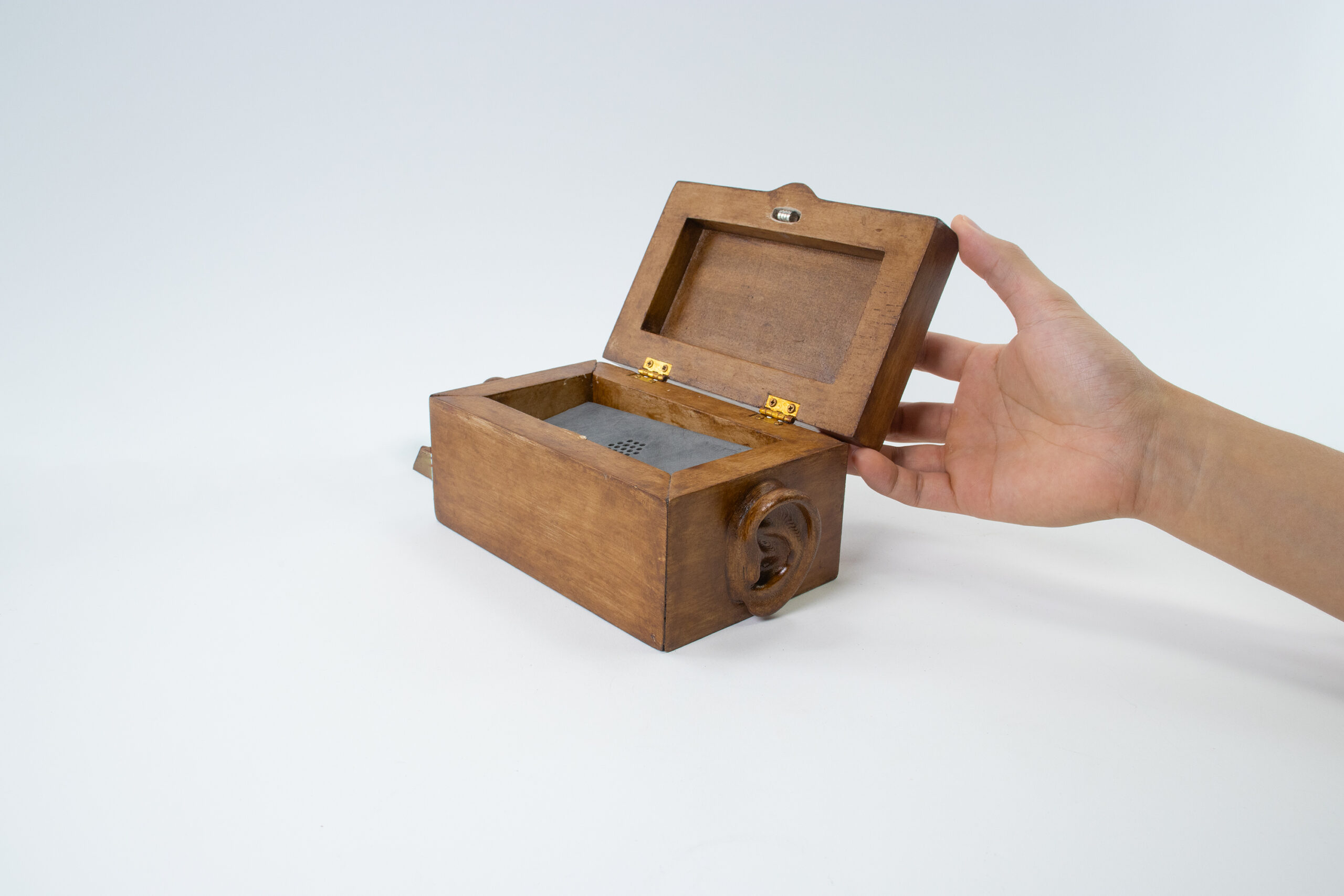
The Poem Box (2024) is a project that explores language through the lens of poetry and AI generated content. In the project, the interactor is presented with a simple wooden box with a closed hinged lid. The box is free from any decorations except for two human-shaped ears located on the left and right side of the box. The interactor sticks their finger into the left ear and starts whispering a secret, confession, or regret into the right ear. This interaction is inspired by the idiom “in one ear and out the other.” When the user finishes whispering, they take their finger out of the left ear. The secret is “held” inside the box until the user decides to swing open the lid of the box. Like an act of release, the opened box beings to recite a poem out loud; the content of this poem is written based on the content that was just previously whispered into the ear of the box. With the “secret” released, although in a transformed state, the box is metaphorically “emptied,” ready to hold and transform the whispers of another interactor.
This project utilizes four different AI models from OpenAI: GPT-4 Turbo is used for text generation, text-to-speech, and speech-to-text, while a fork of the Whisper model called Faster Whisper is used for transcribing text. The interaction is activated by pressing a button switch located in the left ear of the box, which starts a python script that records audio onto a computer. The interactor must hold down the button switch while speaking into a small microphone hidden inside the right ear. When the interactor finishes speaking, they must take their finger out of the left ear, which releases the button switch. This signals the python script to temporarily save the audio recording as an mp3 file. The audio recording is then transcribed to text with Faster Whisper. After the text has been transcribed, another python script sends the text as a prompt to GPT-4 Turbo through the OpenAI Assistant API. The OpenAI Assistant is given the following instructions: “Please write a very short poem about the secret the user submitted.” After receiving the text as a prompt, the OpenAI Assistant uses GPT-4 Turbo to generate a poem based on the content of the prompt, and sends the poem back as text to the python script. OpenAI text-to-speech is then used to create an mp3 audio file of that poem with an AI generated voice. The audio file is kept indefinitely until the lid of the box is swung upon, activating a reed switch. When this reed switch is activated, the python script plays the mp3 audio file of the poem through a small speaker hidden inside the box. When the speaker finishes reciting the poem, the audio file of the poem is deleted. The lid of the box must then be swung closed in order for the python script to loop back to the beginning to start the process all over again.