A Failed Revolution
2019
360° stereoscopic video, archival news footage, color, sound, 03:03 min., virtual reality headset, flat-screen monitor, pedestal
Dimensions variable

Installation view.
On June 5th, 1989, in the aftermath of the Tiananmen Square protests in Beijing, China, a column of government battle tanks used in response to the protests began vacating the area. As the tanks made their way along the northeast edge of the Square, an unidentified man stepped onto the street and obstructed the leading tank. This confrontation lasts for a moment, with the man even climbing on top of the tank, before he is whisked away by a nearby crowd. Images of this event circulated throughout Western mass media, championing the ideal of non-violent resistance against authoritarian regimes, while the same images are subjected to heavy censorship in mainland China even today. The protester has never been identified, yet conflicting mythologies have been built around him: some claiming he was executed by the Chinese government, and others claiming he is alive somewhere on the mainland, or having escaped to Taiwan and is now an archaeologist at the National Palace Museum.
Marked by this plurality, this historical event sparked my interest in exploring ideas of contested histories, the indexicality of photographic documentation, and the dissemination of imagery. I began this exploration by taking a teleological approach to the photographic image: by treating the image as truly an index of the event, it logically follows that the information contained within the image should confirming the absolute veracity of its “truth claim,” regardless of its exploitation as either propaganda or its obfuscation through censorship. I extracted images from video documentation of this event and used photogrammetry in an attempt to create a faithful digital reconstruction of the event in three-dimensions. The picture plane of the images are compared with each other, estimating the location of the camera in three-dimensional space. When a match in subject is found between the images, a point of color is placed in that location, eventually producing a dense point cloud resembling the images.
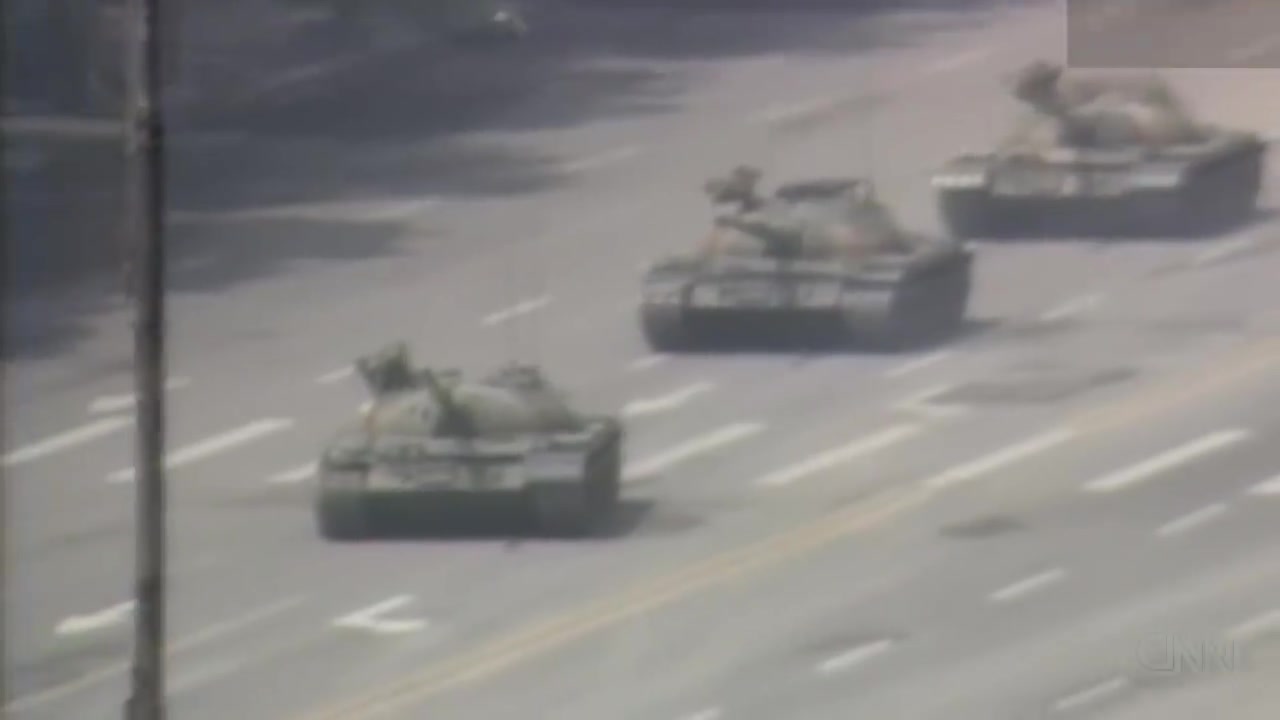
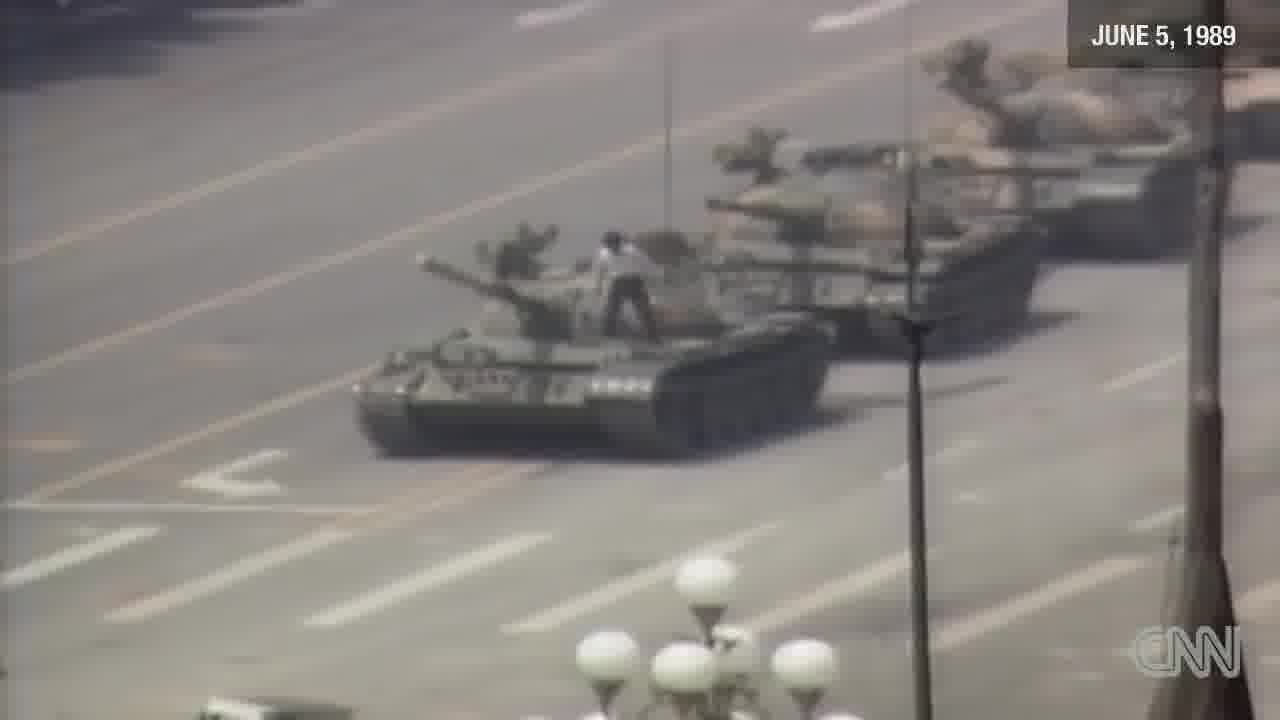
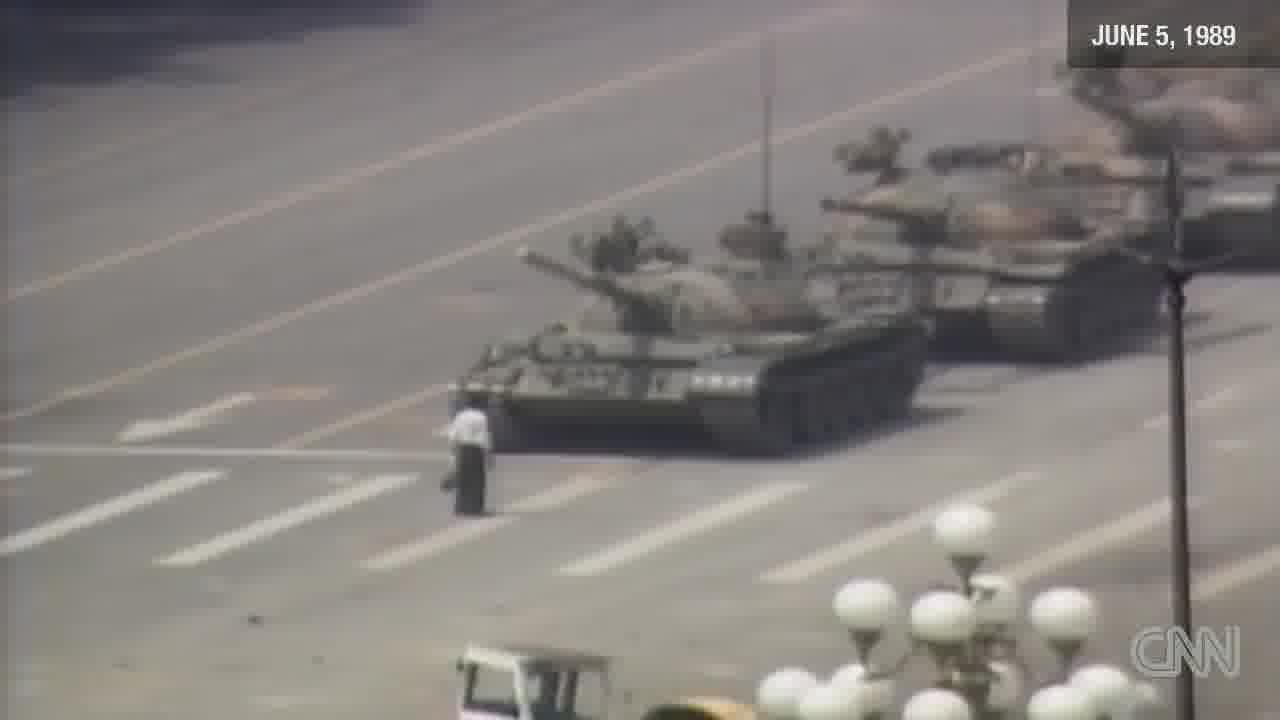
Screen captures from the video documentation of the Tiananmen Square Protest on June 5th, 1989 by photojournalist Jonathan Schaer for CNN.
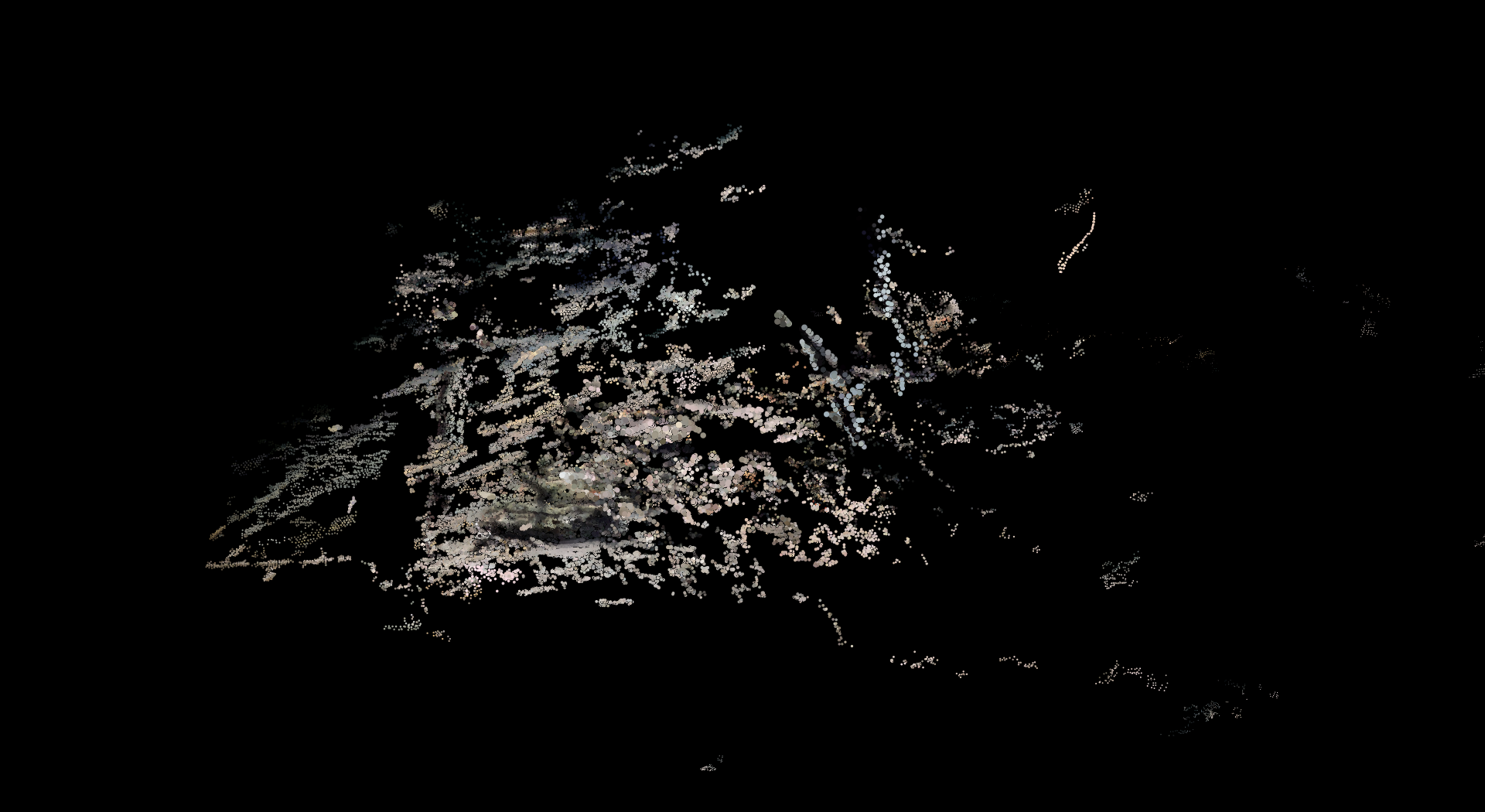
Screenshot of the Dense Point Cloud created from imputing images from this video documentation into a photogrammetry program.
The viewer is placed in a digital environment where the dense point cloud has become a landscape. The viewer is able to explore the environment in first-person point of view and traverse through every nook and cranny of the transformed image. The landscape is composed of individual crystal-like structures, a reference to the silver halide crystals found in conventional photographic film. The translucency of these crystals abstracts the landscape, flattening the foreground, middle ground, and background; the viewer must rely on the beacon of light to guide their way. The experience of navigating through this environment confuses the viewer’s vision, they must rely not on visual information, but rather a sense of space developed while embodying a digital form. When the viewer reaches the beacon, their environment suddenly changes.
The landscape is now flipped perpendicular to the ground, while the viewer still occupies the same position, which happens to be the position of the protester. However, inhabiting this position still does not grant clarity. It is only when the viewer reaches a specific distance from the image that they become cognizant of what the image actually depicts. Whereas the previous iteration compares the likeness of the transformed image with the original image, this iteration asks the viewer to consider how spatiality influences the experience: The physically closeness to the source material obfuscates the image, forcing the viewer to rely on the rules of the picture plane to comprehend its totality.
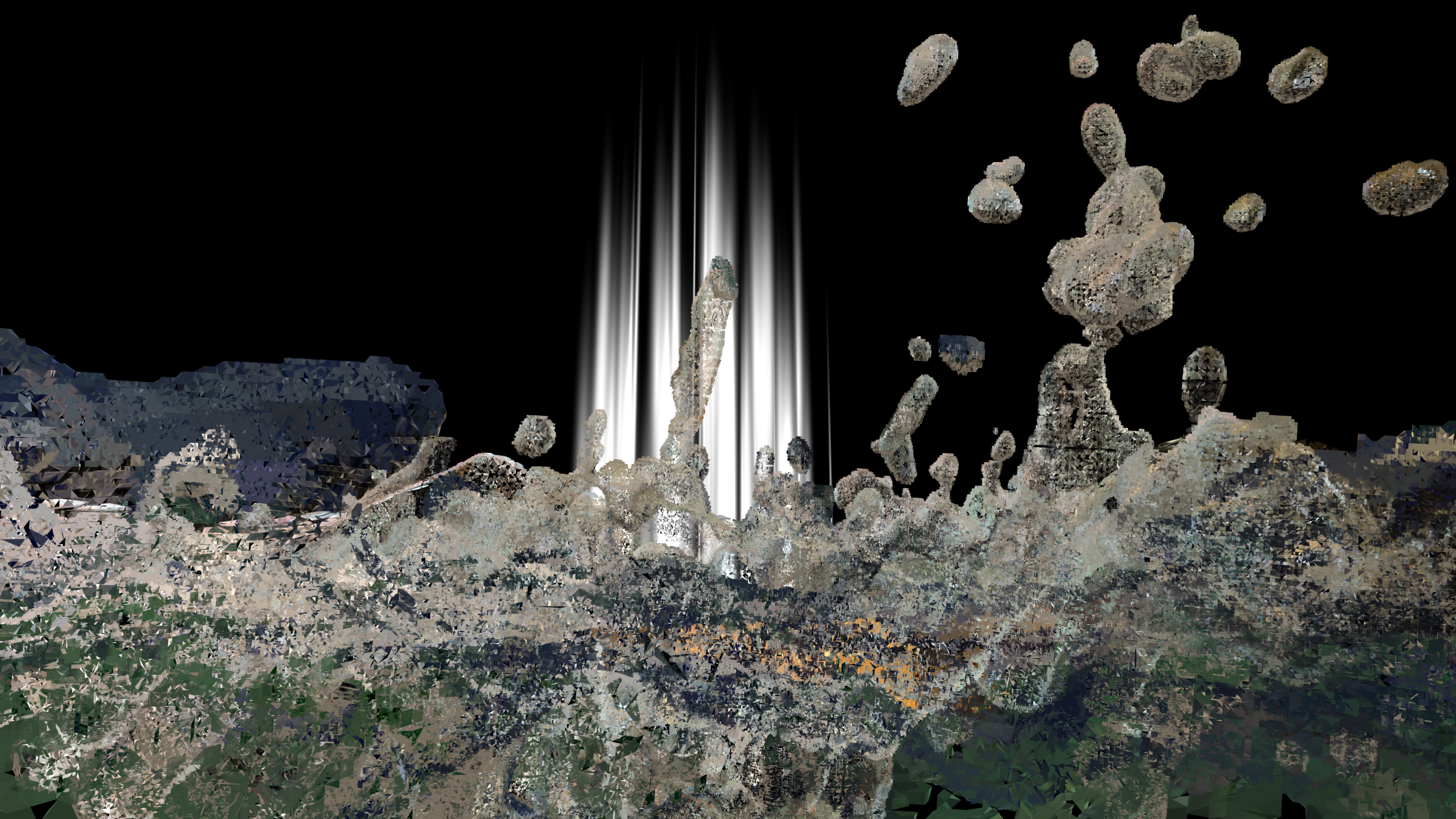
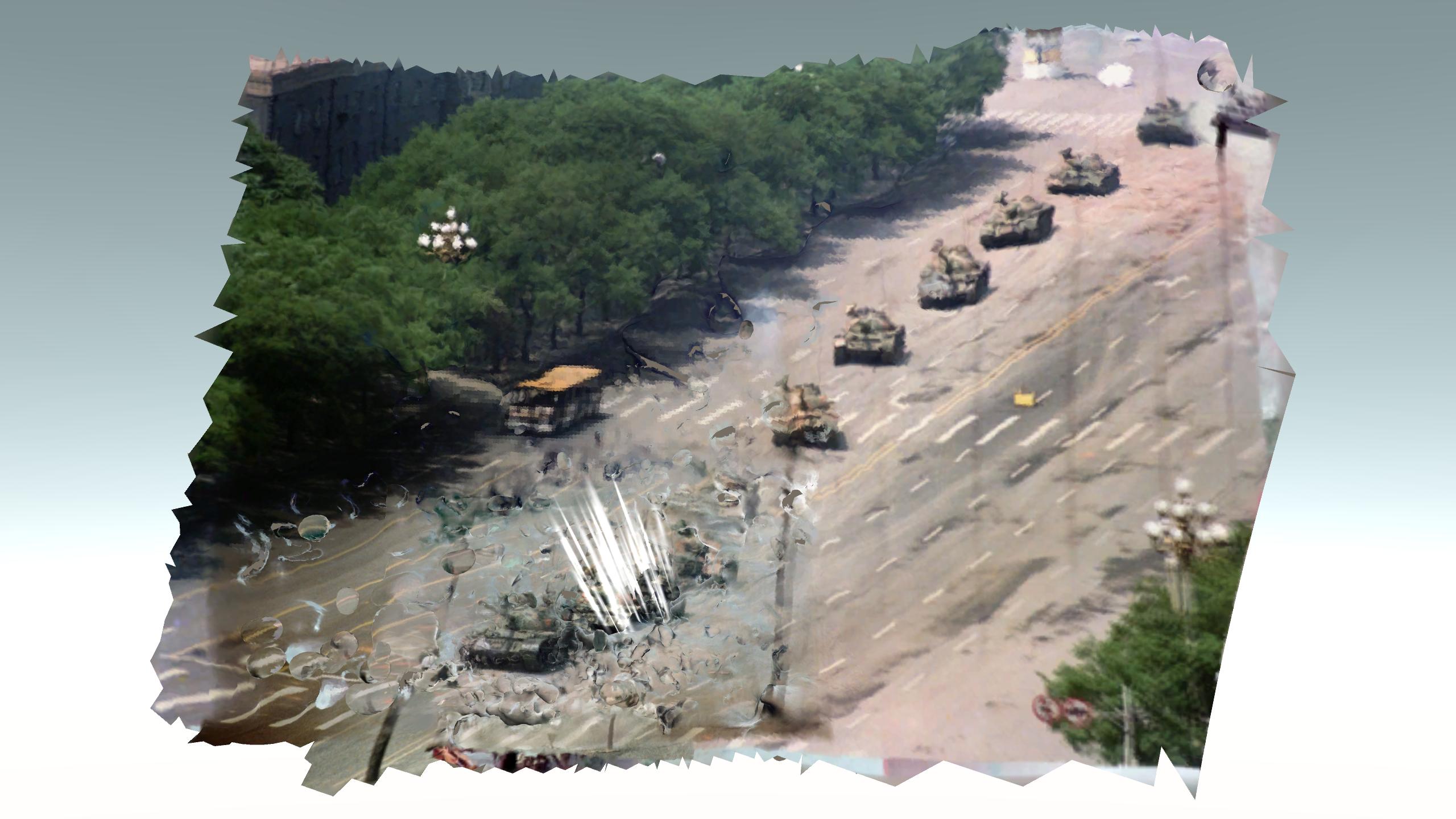
Screen captures of interactive software.
Instructions:
use WASD to move forward, left, backward, and right
use mouse to control camera